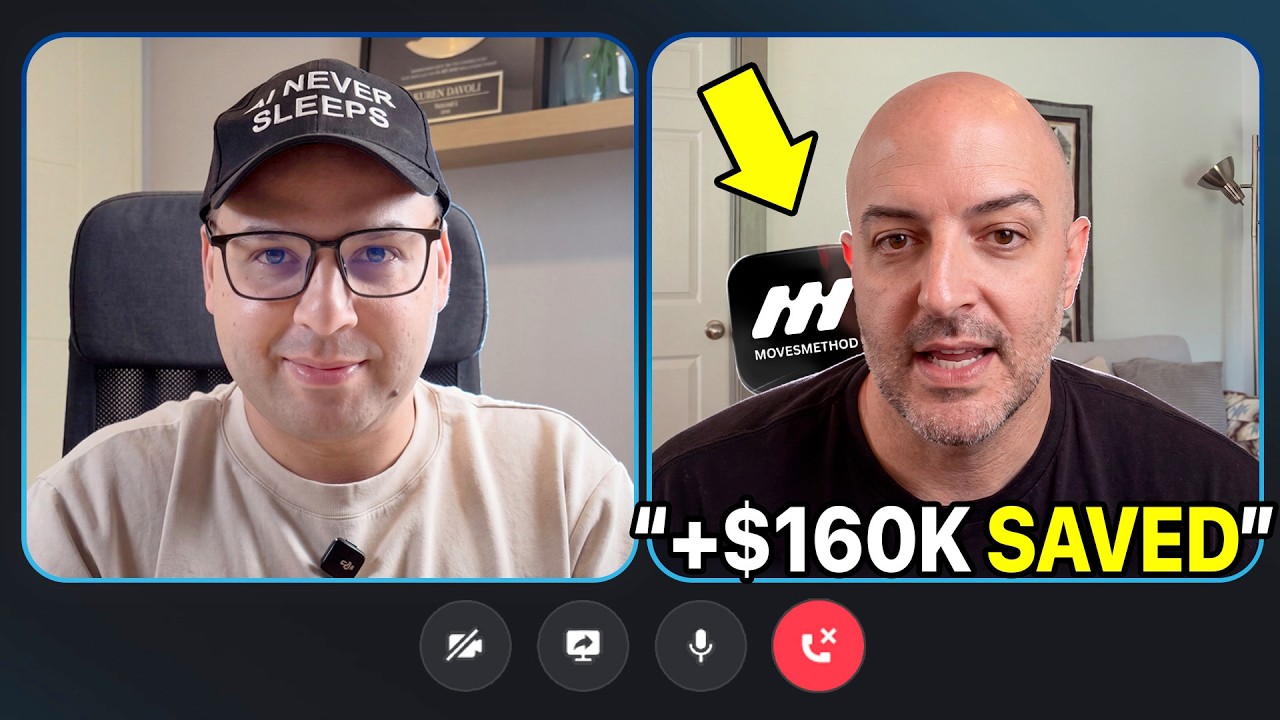
A guy with 15 years in tech, zero sales background, got voted Closer of the Year out of 6,500 people. Here is how, and what he now installs inside companies as a fractional sales leader.
I sat down with Dave Sethi. He came from programming, not sales. In 2018 his dad ended up in ICU and it changed how he looked at his own ceiling in a corporate job. He told his wife to give him 12 months to learn how to close sales on the side. It took 18 months to fully transition. Two years later he was voted Closer of the Year out of 6,500 people in Dan Lok's community.
This is not a hype story. It is a breakdown of what he actually did, and what he does today helping companies between four and thirty five million in revenue fix their sales process.
The test that changed everything
Early on, about 120 people in the community were each given 200 leads. Bad leads. If you could convert them you got bumped to a better tier.
Only two people out of 120 closed anything. Dave was one of them.
He went through every single lead by hand. Looked people up on Facebook. Added them as friends. Messaged them individually. Found relatability. He closed two sales out of 200 in 30 days, while still working his full time job.
It was never about the quality of the list. It was about whether you did the work.
Sales is not what you do to someone
The single biggest lesson he carried forward: sales is not what you do to someone, it is what you do for someone.
If someone has a problem and you can solve it, closing the sale is doing them a favor. That mindset shift removed the ick factor and turned every call into a consulting conversation: understand the problem, understand the desired result, match it to a solution.
He later turned this into a simple framework he still teaches: Problem, Result, Solution.
Stop copying other closers
A lot of people in sales try to copy scripts word for word. Dave says that never works.
- Take the phrases that work from others
- Put them in your own style, your own flavor
- Speak them free flowing so it sounds like a conversation, not a script
A conversation that connects leads to a conversion. A recited script does not.
What he does today as a fractional sales leader
Dave now works as a fractional sales manager and business coach. He goes into companies, uplifts the sales team, puts in process, trains them to a level where they can close, then exits once the company is ready to hire someone permanent.
His sweet spot is companies doing roughly four to thirty five million a year in revenue.
- Below four million, the founder is usually still the one closing
- Four to thirty million, there are gaps: no defined process, no CRM discipline, no training, no pipeline review
- Above thirty million, companies usually have full time sales leadership already
The biggest misconception founders have
Founders think once they hire a sales team, they can step back completely. That is a mistake.
His phrase: people won't do what you expect, they'll do what you inspect. Step in, check the work, step back out. Repeat.
Second misconception: founders assume the sales team will train itself. It does not. Markets shift. Teams need fresh angles, coaching, and process updates on an ongoing basis.
Sales process before automation, always
When Dave walks into a company, the first thing he maps is the sales process: the full journey from stranger to customer.
If that process is not clearly defined, no amount of automation will fix anything. You will just scale the problem.
His sequence:
- Talk to customers manually first and capture the actual phrases they use
- Confirm the process works manually
- Automate what already works
- Layer AI on top of what is already automated and proven
One pattern he sees constantly: ask four different salespeople on the same team to pitch the offer, and you get four different answers. That inconsistency creates confusion in the market before a prospect even gets on a call.
Sales, marketing, and delivery need to talk to each other
Dave frames the business as three teams: marketing gets attention, sales converts attention, delivery fulfills the promise. When sales hears an objection it cannot close, that objection should go straight to marketing to turn into content. When delivery hears about a bad-fit client, that feedback should go back to sales as a qualifying filter.
The bigger the company gets, the more these three teams disconnect, not less. He has seen this breakdown in companies worth over 150 million.
Hire for culture over performance
Dave uses a simple quadrant: performance on one axis, culture on the other.
- High performance, low culture: closes deals but becomes toxic and hard to manage
- Low performance, low culture: no reason to keep them
- Low performance, high culture: coachable, can be trained
- High performance, high culture: the person you build around
He would hire for culture over performance every time. A high performer with low culture spreads ego through the whole team. His fix before firing: pair the high performer with a high culture, lower performer. Let the second person learn and document everything. Once that person's results improve, you can let the toxic high performer go without taking a hit to revenue.
His rule: hire fast, fire after you have a plan, not fire fast blindly.
Coaching style changes with seniority
With a junior rep, Dave is more directive: here is the scenario, try this, let's role play it. With a senior rep, he asks permission first, brings evidence of what he observed, and asks them to explain their approach before offering his own. In both cases he asks "are you open to feedback" before giving it. If someone says no, that tells him they are not coachable.
Where AI actually helps, and where it doesn't
AI cannot replace judgment. Years of pattern recognition from being in the trenches is not something you can prompt your way into. If you do not know what question to ask, AI will answer the wrong one confidently.
Where AI is genuinely useful:
- Reviewing hundreds of call recordings against a defined framework and scoring them
- Summarizing transcripts and spotting patterns in wins and losses
- Handling repetitive admin work that salespeople avoid
Where Dave still insists on manual work: taking notes during a live call. Writing it down by hand keeps the rep present and engaged, and repeating a prospect's own words back to them builds trust in the moment. Automation can run in parallel, but it should not replace that in-call attention.
The follow up formula: one, one, infinite
A mistake Dave made early and sees constantly in others: treating "no" as final.
No doesn't mean no. It means not yet.
His formula:
- One: try to close in the first conversation
- One: follow up at least once a week after that
- Infinite: keep following up indefinitely
Three traits in every successful sales person
- Problem solving mindset: "I'll figure it out" instead of giving up
- Curiosity: asking why a sale closed or didn't, so wins can be repeated and losses fixed
- Volume: quality comes from quantity, not around it
Why human connection still wins
Dave has been doing this since 2018. The biggest shift he has noticed is information overload. Everyone online says the same things, has the same reviews, follows the same structure. Trust has become harder to earn, not easier.
Automation can carry outbound and qualification. But somewhere in the customer journey, a human still has to show up. That is still what breaks the ice and closes the gap that automation alone cannot close.
-Ruben
Grow your revenue or cut your costs in 90 days. Or you don't pay.
Done-for-you AI systems, the same ones I run in my own agency and build for 7 and 8-figure coaching and consulting businesses. Want them installed for you? Let's talk.